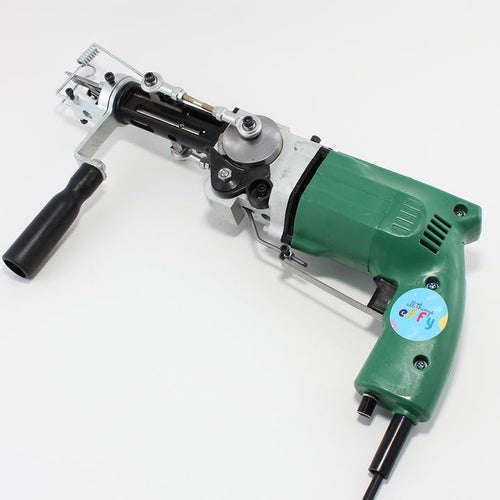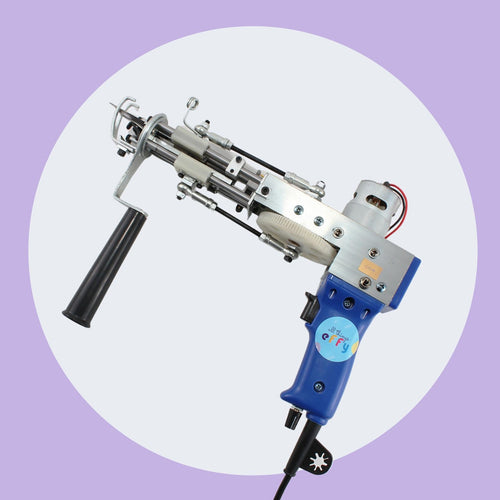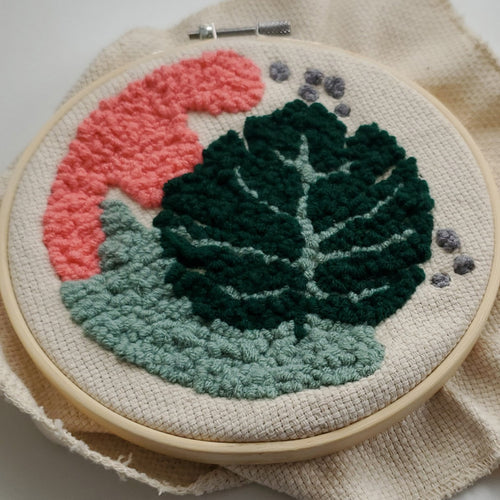



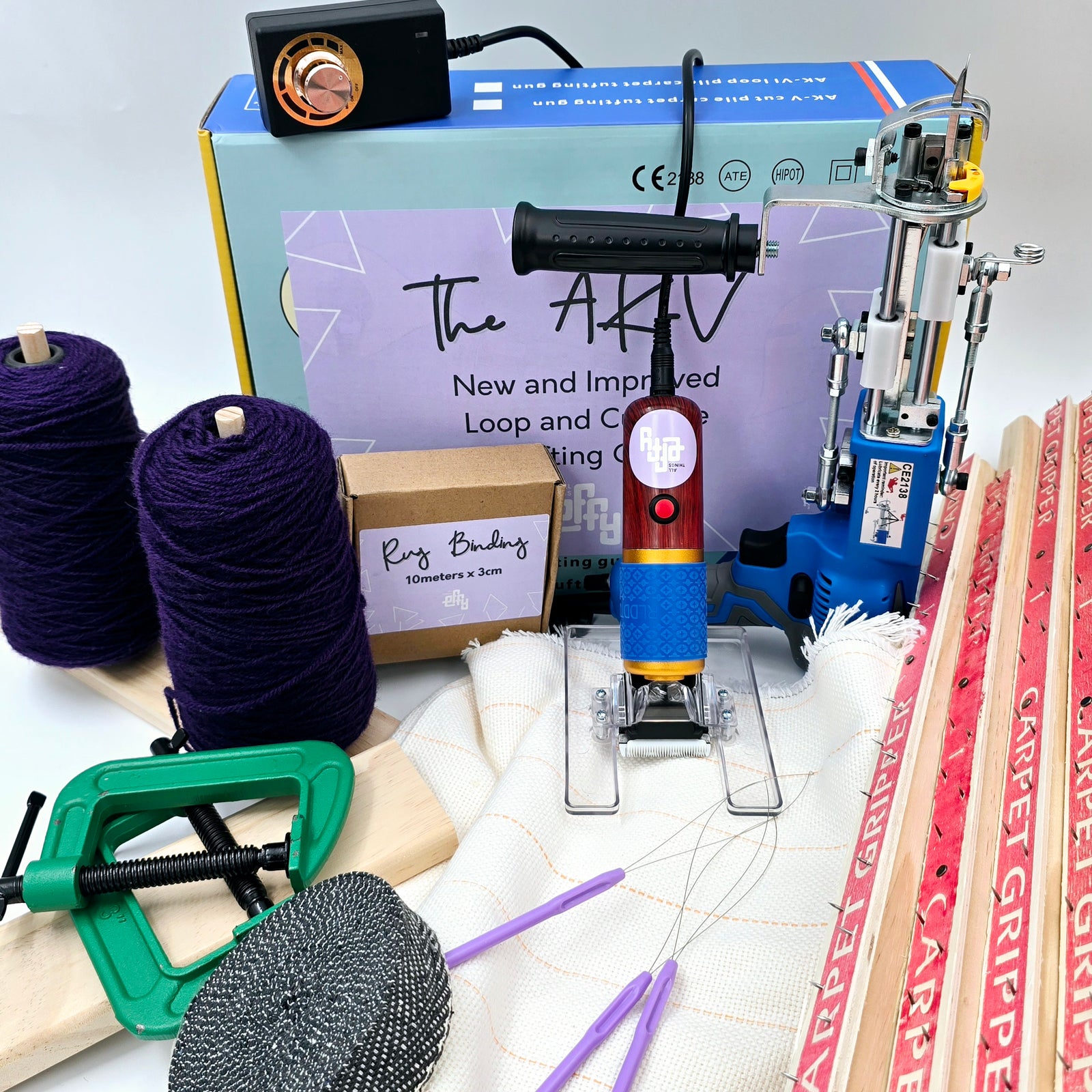


One of the most common questions I get asked is:
Is there a tufting machine that can do cut pile, loop pile, and multiple pile heights?
Absolutely—the AK-III can do all three. But it is a more expensive setup, requiring a suitable air compressor, additional equipment and manual adjustments to the machine. Changing heights and pile types means taking the time to change tips, feeding-wheel settings and the cut or loop setup as needed.
If you do not have the space for that equipment, or simply do not want the complexity of changing the setup, there is another option: an AK-V, a Mid Pile Duo and a High Pile Duo. Each arrives set to a different cut-pile height, so you can switch between machines without readjusting their pile heights. After normal threading and preparation, you can start tufting. Converting them to loop pile still involves a manual adjustment, which I explain below.
Personally, I prefer having the three machines ready at their supplied heights. I like being able to pick up the machine I need and get on with my rug—perhaps that is the slightly lazy tufter in me! The AK-III’s height changes are actually straightforward once you learn them: you interchange set parts and repeat the same process. My preference is about having fewer setup steps between sections of a rug.
That does not mean the three-machine setup is best for every project. For a large high-pile rug, I would choose the AK-III. Here is how I think about the differences, including comfort, yarn usage, space, noise and cost.
I recommend both options for working with multiple pile heights: the three electronic guns, or the AK-III with its air setup. The right choice depends on how you want to work, your projects and your available space. Below, I compare the machines and costs first, then explain loop pile, adjustments, maintenance and the AK-III’s technical setup.
Understanding pile height
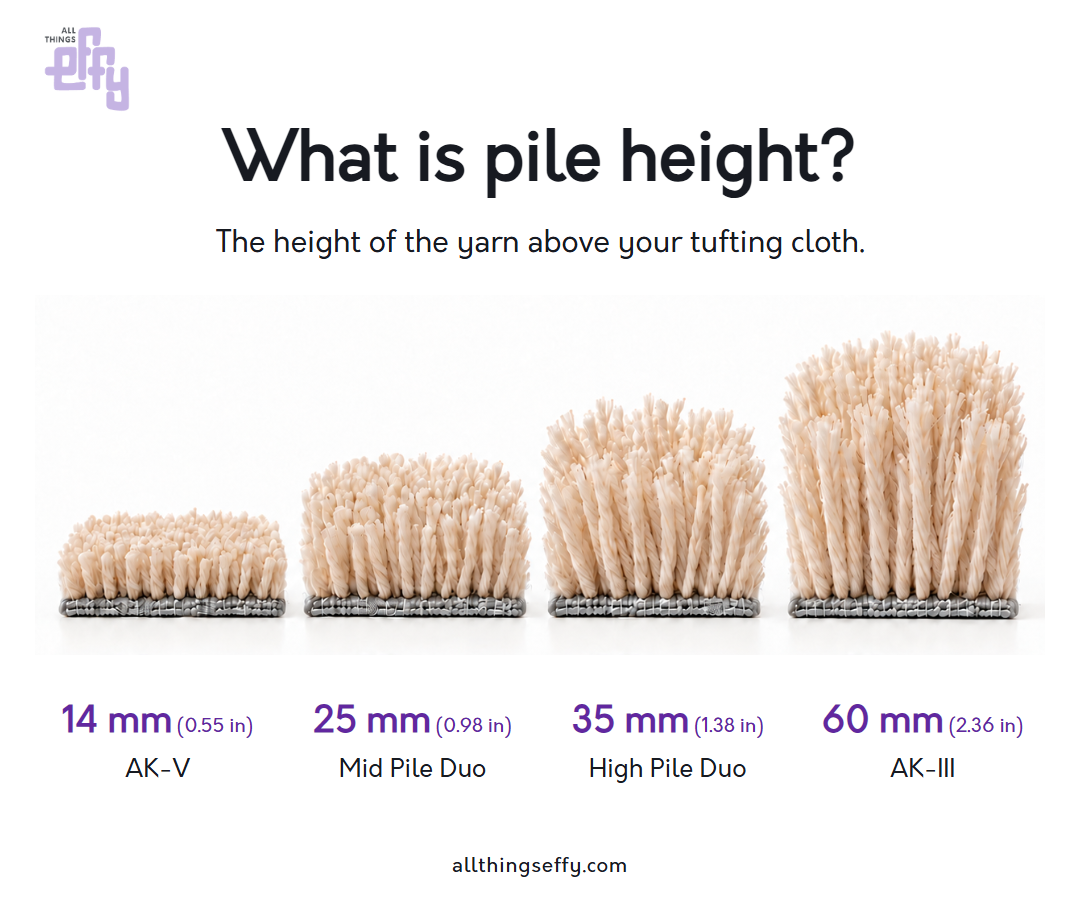
Pile height is the height of the yarn above your tufting cloth. The measurements below describe the height you tuft before finishing. Trimming and carving can reduce the finished height, so keep that in mind when planning your design.
| Machine | Supplied cut-pile height | Mechanically adjustable cut-pile range |
|---|---|---|
| AK-V | 14 mm (0.55 in) | 7–18 mm (0.28–0.71 in) |
| Mid Pile Duo | 25 mm (0.98 in) | 25–30 mm (0.98–1.18 in) |
| High Pile Duo | 35 mm (1.38 in) | 30–45 mm (1.18–1.77 in) |
| AK-III | Depends on the fitted tip and setup | 18–60 mm (0.71–2.36 in), with manual tip changes |
For the AK-V, Mid Pile Duo and High Pile Duo, pile-height adjustment is mechanically possible, but due to the complexity of these alterations, changing the supplied pile height voids your EFFY machine warranty. The ranges describe mechanical capability; the supplied heights are the settings used for our three-gun comparison.
The electronic-machine ranges above are for cut pile. The AK-III supports both cut and loop pile across its full 18–60 mm (0.71–2.36 in) range.
The AK-III example in our pile-height image shows its maximum height of 60 mm (2.36 in).
Pile height and pile type are separate things. Cut pile has cut yarn ends; loop pile retains loops. The AK-III can produce both cut and loop pile across its full 18–60 mm range.
01THE ELECTRONIC SETUPThree electronic tufting guns
The AK-V, Mid Pile Duo and High Pile Duo give you three supplied heights: 14 mm, 25 mm and 35 mm.
To combine these heights, you switch between the guns. No air compressor is required, which means fewer pieces of equipment to accommodate in your workspace.
Buying all three gives you the complete set of supplied heights, ready to switch between as you work. If you are starting out on a budget, the AK-V at 14 mm (0.55 in) is a good starting point, and you can add the other machines later.
 AK-V: 14 mm (0.55 in)
The AK-V comes supplied at 14 mm (0.55 in), with a mechanically adjustable cut-pile range of 7–18 mm (0.28–0.71 in). It provides the shortest supplied pile height in this comparison.
Watch: AK-V beginner tutorial: setup, maintenance and threading.
Don’t panic—14 mm (0.55 in) is plenty!
I think the number sometimes makes people worry that the pile will be too short. In practice, 14 mm gives you plenty of scope for tufting, trimming and carving. It works well for everyday rugs and alongside the taller heights in the three-machine setup. If your budget only stretches to one machine for now, it is a good place to start.
 Mid Pile Duo: 25 mm (0.98 in)
The Mid Pile Duo comes supplied at 25 mm (0.98 in), with a mechanically adjustable cut-pile range of 25–30 mm (0.98–1.18 in). It gives you a second height to combine with shorter or taller sections.
Could the Mid Pile Duo be your everyday machine?
I sometimes get asked whether this would make a good primary machine because its height sits in the middle. My preference is to use it for adding texture alongside the AK-V.
The Mid Pile Duo is a modified version that uses the AK-DUO body, adapted for a longer pile. It does not have the standard AK-DUO’s dedicated loop-pile head; it creates loops using the loop-pile hack explained below.
In my experience, the Mid Pile Duo can sometimes pause at different points in its cycle. You might notice the scissors stop extended rather than in their usual resting position. Pressing the trigger again usually resets the cycle just fine. It can be a little startling the first time you see it, and irritating if it interrupts your rhythm, but it does not automatically mean something is wrong with the machine. It is one reason I prefer it for adding texture alongside the AK-V rather than choosing it as my everyday machine.
 High Pile Duo: 35 mm (1.38 in)
The High Pile Duo comes supplied at 35 mm (1.38 in), with a mechanically adjustable cut-pile range of 30–45 mm (1.18–1.77 in). It has the tallest supplied height among these three electronic machines.
Watch: Welcome to your High Pile AK DUO.
High-pile details or a whole high-pile rug?
I love the Mid and High Pile Duo for adding sections of texture, but they do not feel as smooth to use as the AK-V. The longer working cycle is particularly noticeable on the High Pile Duo: there is more vibration and kickback, and it takes more effort to keep the machine steady against the cloth.
It can make a whole high-pile rug, but for a large project I would personally choose the AK-III. Long sessions with the High Pile Duo can be tiring, and the vibration can mean occasional adjustments are needed to restore clean cutting. I see it as a useful way to add high-pile details, with a different working feel from an everyday short-pile gun.

02THE PNEUMATIC SETUPAK-III with an air setup
The AK-III produces cut and loop pile across the full 18–60 mm (0.71–2.36 in) range. You change heights by manually swapping tips and setting up the machine accordingly.
Although there is more equipment to learn, I find the actual height-change process less finicky than adjusting the electronic guns. The AK-III has set parts that you interchange. Once you understand the process, it is straightforward and repeatable, rather than having to work out a new combination of fine adjustments each time.
This gives you multiple heights from one gun, but it also requires additional equipment. The AK-III uses both electricity and compressed air: the electrical system drives the moving mechanism, while airflow feeds yarn through the tip.
Our complete AK-III setup guide explains the air system, fittings, tip pressure settings, blade alignment and timing checks.
What does each setup cost?
Three electronic guns: regular prices
| Store currency | AK-V | Mid Pile Duo | High Pile Duo | Three-gun total |
|---|---|---|---|---|
| USD | $305 | $370 | $380 | $1,055 |
| CAD | $445 | $485 | $520 | $1,450 |
| AUD | $480 | $490 | $562 | $1,532 |
| NZD | $580 | $570 | $630 | $1,780 |
Complete AK-III setup example
This example includes the gun and the air equipment needed for the setup.
| Item | Estimated cost in USD |
|---|---|
| AK-III | $980 |
| Suitable compressor | ≈$610 |
| Filter/lubricator | ≈$41 |
| Air-tool oil | ≈$17 |
| Air hose | ≈$17 |
| Fittings | ≈$35 |
| Estimated total | ≈$1,700 |
The same estimated total converted into other currencies:
≈ US$1,700 · CA$2,360 · AU$2,370 · NZ$2,920
Additional information about the electronic tufting guns
What about loop pile?
Yes—the AK-V, Mid Pile Duo and High Pile Duo can all make loop pile! You use a simple adjustment I call the “loop-pile hack”—I didn’t know what else to name it! It prevents the scissors from fully closing so the yarn stays in loops instead of being cut. My videos below show you how to do it.
You do not need to buy a dedicated loop-pile machine just to try loops. However, if you expect to do a lot of loop-pile work, I think an AK-II is an excellent investment: you can keep it ready for loops without converting your cut-pile gun back and forth. That is a separate option from the two multiple-height setups compared here.
Loop pile takes a little more patience
Remember that with loop pile, you need to cut the yarn by hand each time you finish a line. It is also less forgiving of changes in your technique. Keep the machine at a consistent 90-degree angle to the cloth: tilting it up or down can change the height of your loops. Inconsistent pressure against the cloth can also produce uneven loop heights.
That makes loop pile a slower process than cut pile, which is one reason I think you see cut-pile rugs more often. But loop pile can be beautiful, and I think it is worth taking the time to learn.
Personally, I prefer the look of the loops I get using the hack on the AK-V to those from the AK-II. The AK-II produces a shorter, more nubbly texture, while the AK-V gives me longer, plush loops that I really love. You can see the difference in my AK-V loop-pile tutorial below, which includes testing and a comparison with the AK-II.
Watch our loop-pile demonstrations:
- AK-V: converting to loop pile, testing and AK-II comparison
- High Pile AK DUO: using your machine for loop pile
The Mid Pile Duo uses exactly the same loop-pile technique as the High Pile Duo, so follow the same process shown in the High Pile Duo video. These machines share the same basic mechanism; their longer bodies accommodate the different pile heights.
Can you adjust their pile heights?
Pile-height adjustment is mechanically possible, but due to the complexity of these alterations, changing the supplied pile height voids your EFFY machine warranty.
For the three-gun setup described here, keep each machine at its supplied height and switch guns when you want a different height.
For the AK-V, the mechanical range is 7–18 mm (0.28–0.71 in). Personally, I do not find the visual difference worth the adjustment for most of my projects. I can achieve much of the variation I want by carving the supplied 14 mm pile. Carving only removes yarn, of course—it cannot create a taller pile.
Why I recommend the supplied settings
Being able to reach a maximum height does not necessarily make that the most comfortable setting for everyday use. Over years of selling these machines and listening to customer feedback, we have refined our supplied settings to favour balanced, consistent operation.
Working towards the limits of a machine’s travel can mean more vibration and more attention to its adjustment. Tufting machines are sensitive. Even a 1 mm difference can affect how the machine works. For example, moving the scissor opener up or down by just 1 mm can change how the machine cuts.
If you want a different height set before dispatch, email us to discuss it. We can arrange alternative settings, but I would still recommend our usual supplied height for the smoothest everyday experience. Having us set a height before dispatch is separate from altering it yourself afterwards.
Could you buy one high-pile gun and carve everything down?
You can, but I would not choose that approach for mostly short-pile work. You are using extra yarn to create height that you then cut away, as well as spending more time trimming it. Across repeated projects, that waste can become expensive.
Using the AK-V for shorter sections and the Mid or High Pile Duo for taller sections lets you put the extra yarn where you want it, rather than paying for yarn that ends up on the floor. If buying the full set is outside your budget, you can build towards it over time.
Understanding pile-height adjustments: our AK-I video guides
Our AK-I videos explain the underlying adjustment principles used by the electronic machines in this comparison. They share key components: a scissor opener, a scissor closer and a repeating mechanical cycle that coordinates the needle and scissors. The AK-V uses a belt drive, while the AK-I and Mid and High Pile Duo use a cog wheel, but understanding how these components work together is the starting point.
The videos demonstrate the AK-I. They explain the process, rather than providing measurements or identical adjustment steps for every model:
- Pile-height adjustment — Part 1: 10 mm to 18 mm (0.39 in to 0.71 in)
- Pile-height adjustment: 18 mm to 10 mm (0.71 in to 0.39 in)
- Pile-height adjustment — Part 3: 18 mm to 14 mm (0.71 in to 0.55 in)
We have deliberately kept our pile-height adjustment tutorials limited because these changes can be complex. An incorrect adjustment can affect the machine’s timing, cause damage and be difficult to undo. We want owners to understand what is involved before starting.
If you are mechanically confident and understand the process demonstrated on the AK-I, you may choose to apply those principles to your machine. Take and record your original measurements first, and work carefully. Any adjustment is undertaken at your own risk. Changing the supplied pile height voids your EFFY machine warranty.
Tools, measurements and understanding your machine
With electronic tufting guns, precision is easy to underestimate. If the scissor opener, scissor closer or the length of an adjustable bar is off by just 1 mm (0.04 in), it can change how the machine tufts. That sensitivity is what makes pile-height adjustment both difficult to demonstrate and tricky to carry out accurately.
If you are going to make adjustments, I cannot recommend digital calipers strongly enough. I recommend them for pretty much any change: record your original measurements before touching the settings, then measure accurately as you work. The depth-measurement arm is particularly useful for recording the scissor-closer position so you have a reference when returning to cut pile.
Take time to understand the cycle of your gun, too: how the scissors open and how they close. I cannot emphasise enough how useful it is to learn to adjust the scissor opener and closer and replace your scissors. These are the key skills I recommend learning to keep your machine working well. Understanding that sequence makes it much easier to recognise what has changed if the machine stops tufting as well as it did.
After all, these are machines. They need to be understood and cared for. You cannot expect to take a tufting gun out of the box and have it work exactly the same way for its entire lifespan without maintenance. Parts wear, scissors need replacing, and settings can shift with use. You do not need to become an expert overnight, but learning those basics is part of owning a tufting machine—and it can save you a lot of frustration.
A small maintenance issue can look like a faulty machine
I sometimes hear from customers who think their machine needs to be returned, when the scissors have picked up a nick and need replacing, or the scissor opener or closer has vibrated slightly out of position. These are often straightforward maintenance jobs you can do at home with the supplied tools and the appropriate guide.
A small correction to an opener or closer that has shifted can restore clean cutting. The key is to identify what has moved and use your recorded measurements, rather than changing settings at random. Switch off and unplug the machine before working on it.
Keep the Allen keys and replacement parts supplied with your machine—they are there to be used and are very useful. Maintaining the original setup is a different job from changing its pile height; the pile-height warranty restriction explained above still applies.
Can we give you measurements to restore the factory settings?
Not as a guaranteed reset. We can give you approximate measurements to show where the parts should sit, but even 0.5–1 mm can affect how your machine works. Those measurements are a starting point, not a substitute for understanding the cycle of your gun.
You still need to understand how the scissor opener and closer work together, and be comfortable testing a few small changes in position before you are happy with how the machine tufts. Record each change so you know what you have tried, and switch off and unplug the machine before making the next adjustment.
My recommended order is:
- Understand the cycle of your machine. Learn how the scissors open and close, and how to recognise when that sequence is working correctly.
- Take measurements of your own machine while it is working well. Use digital calipers and keep those measurements as your reference before changing anything.
- Only then explore pile-height adjustment. Make sure you fully understand the cycle and your original settings first. Changing the supplied pile height remains at your own risk and voids your EFFY machine warranty.
Understanding the AK-III air setup
Choosing a suitable compressor
Check the compressor’s delivered airflow as well as its tank capacity. Our setup guide lists a minimum 60 L tank and 200 L/min (7 CFM) airflow, with working-pressure requirements and a recommended 10-bar compressor specification. Check the full guide before purchasing, rather than choosing by tank size alone.
You will also need a suitable hose and fittings, a filter/lubricator and air-tool oil. Connections can differ between countries, so use the guide’s examples to identify compatible equipment for your location.
Space and noise matter too
Allow room for the compressor, hose and accessories as well as your tufting frame.
The compressor also makes the AK-III setup noisier than the electronic-gun setup. Consider where you will work, when you will use it and whether the space is suitable for the extra noise.
AK-III setup videos
These tutorials are linked from our complete setup guide:
- Understanding air compressors
- How to attach your air hose
- Changing the AK-III from cut pile to loop pile
- Changing the feeding wheel size
Which setup fits your workspace?
The three electronic guns give you 14 mm (0.55 in), 25 mm (0.98 in) and 35 mm (1.38 in) at their supplied settings. I recommend this setup if you want to switch between those heights without readjusting a machine or adding an air compressor. You can buy the complete set, or start with the AK-V if you are working within a smaller budget.
The AK-III gives you cut and loop pile from 18 mm to 60 mm through manual tip changes. Plan for a larger upfront investment, more equipment, extra space and compressor noise.
These setups offer different height options. Start with the heights you want to achieve, then consider the equipment your workspace and budget can accommodate.
Explore your local store: USA, Canada, Australia or New Zealand.
For a broader introduction to the different machine types, explore EFFY’s complete tufting-gun guide. The supplied heights used in this article are 14 mm, 25 mm and 35 mm for the three electronic machines compared here.
For the full pneumatic setup walkthrough, read our complete AK-III guide.